SEMA 2026: Visit 360 Payments at Booth 11253!
Visit 360 Payments at SEMA 2026, Booth 11253! See Text-to-Pay, financing & show specials.

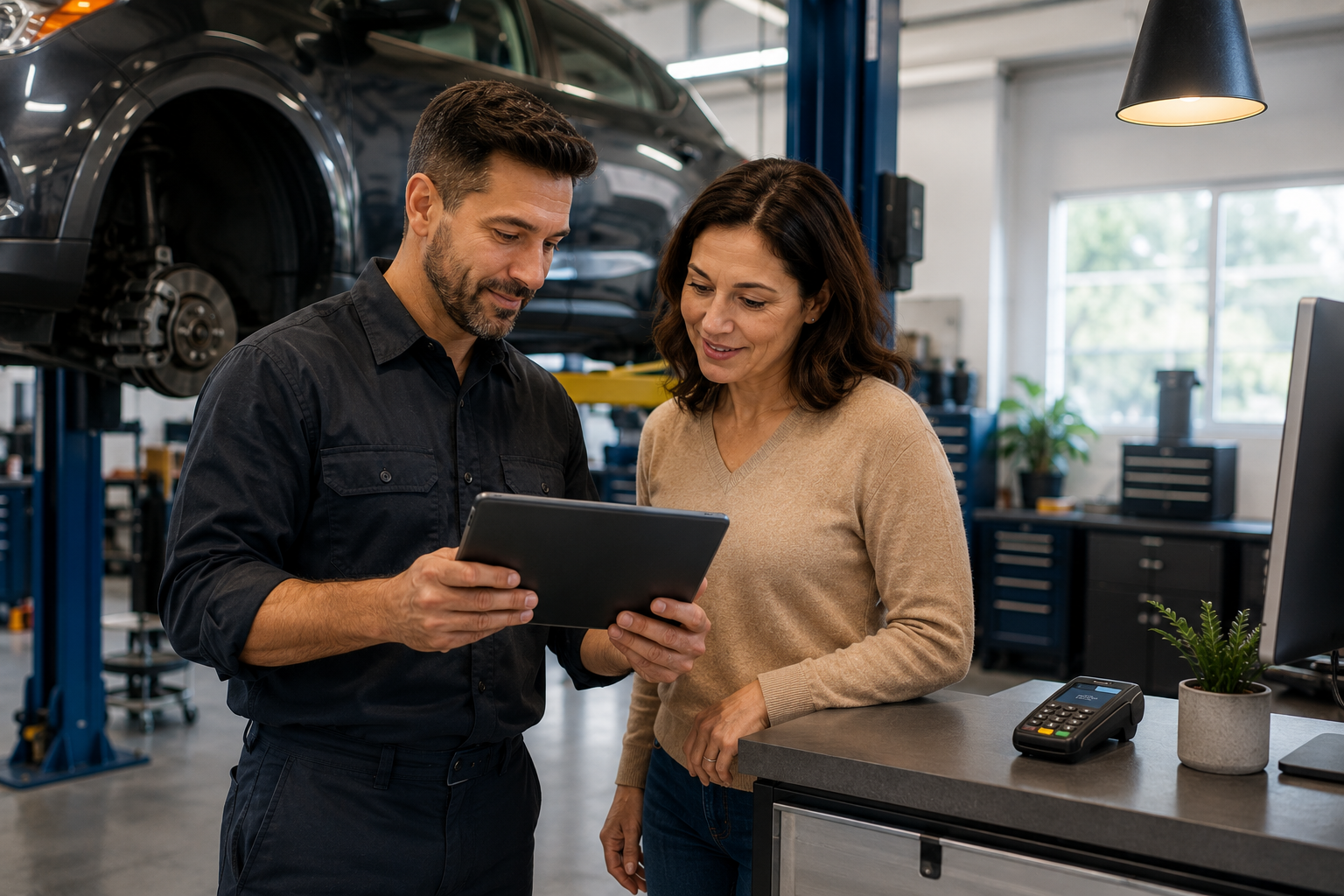
The independent repair shop has changed more in the last five years than it did in the previous fifteen. Customers behave differently. Vehicles look different under the hood. And new tools are quietly rewriting how shops operate day to day.
In a recent episode of the Full 360 Wrap, host Jesse sat down with Gavin Robinson to break down three trends that are changing the way repair shops run. Below, you'll get the practical takeaways from that conversation, plus what each shift means for your bottom line. By the end, you'll know where to focus first to build repeatable revenue, keep pace with complex vehicles, and remove friction from every customer interaction.
Here's the core shift. Today's consumer is far more mature than they were three or four years ago. They've been trained by every online purchase they've ever made, and they bring those same expectations into your shop.
When someone gets a surprise flat or an engine warning light, they don't have a shop on speed dial. They go straight to their phone, just like they do for everything else. They're looking for three things:
The mistake many shops make is walling off these expectations based on how their internal process works. If you use one vendor for scheduling, another for inspections, and a third for payments, the customer feels every seam. And they didn't sign up for your operational complexity.
One of Gavin's sharpest points centered on the ideal customer profile, or ICP. Most shop owners already have their best customers sitting in their shop management system or CRM, whether they've segmented them yet or not.
The exercise is simple but powerful. Identify the customer who delivers repeatable revenue, the one likely to stay with you for 10, 12, or even 15 years. Then market to that person consistently. This is where acquisition pays off long term.
Acquisition brings customers in. Digital vehicle inspections (DVIs) keep them coming back. And the data here is hard to ignore.
Based on more than four years of DVI sharing data, sharing an inspection with a customer creates roughly a 30% higher close opportunity than not sharing one. The average repair order (ARO) climbs too. When an inspection gets shared, AROs can run north of $800 to $900, compared to around $380 when it isn't.
Why? Because photos, videos, and documented findings build trust and transparency. Customers approve recommended work when they can see exactly what's happening with their vehicle.
Vehicle age is climbing, and the data tells a clear story. Drawing from a pool of more than 387 million vehicle records across shop management systems, the breakdown looks like this:
Some of this traces back to inventory shortages during the pandemic. A lot of it comes down to people simply holding onto their vehicles longer. Either way, the takeaway is the same. You have to service a wider spectrum of vehicles than ever before.
That spectrum creates a real challenge. Your team needs to work confidently on a 20-year-old sedan and a late-model vehicle packed with advanced electronics and driver-assistance systems. That requires the right tools, the right systems, and increasingly, the right technicians.
Gavin framed this as an opportunity, not a burden, and pointed to two shifts worth watching.
First, more owners are stepping out of the bay to work on the business rather than in it. There's nothing wrong with an owner-operator who loves fixing cars. But separating yourself from daily repair work frees you to focus on strategy and growth.
Second, there's real relief coming on the technician front. Organizations like SkillsUSA run training and competitions to bring young talent into the trades. State and national legislation has moved to approve scholarships and loan relief for people entering skilled trades, including technicians. The next generation arriving in shops has grown up with technology as second nature, which helps bridge the gap between older and newer vehicles.
Skip the hype for a moment. The honest headline on AI in auto repair is this: it's not an emerging technology anymore. It's part of daily life, and it's already woven into the software you likely use.
Look around and you'll find it:
Flipping the switch on these features is often the easiest way to dip your toe in, because they build on tools you already trust.
The bigger opportunity hasn't fully arrived yet, and it lives in your data. Shop owners, coaches, and consultants are already pulling their own business data to generate insights. Many do it the ad hoc way, dropping a raw CSV file into a chatbot and asking for answers. That's a start, but it isn't the best long-term path.
What's coming is more prescriptive. Providers are working on secure connectors, like model context protocols (MCPs), that link AI tools directly to your business data. Consider this: customer API data requests have tripled over the last two years. The demand for connected, data-driven insight is real and growing fast.
Here's the caution worth repeating. Don't let AI make business decisions for you.
AI is a complement to your judgment, not a replacement for it. There's plenty of polished-sounding output out there that's only as good as the inputs behind it. Set your own thresholds for what success looks like at your shop, then use AI to surface the key indicators that get you there. You define the strategy. AI helps you execute it.
Every trend above points to the same principle: remove friction. Make it easier for customers to do business with you, and easier for your team to do their jobs. Nowhere is that clearer than at checkout.
Too many shops still treat payment as a separate step bolted onto the end of the job. But payment is the number one goal of the entire process. You provide an expert service, so getting paid should feel effortless, not like a big, complicated production.
Think about your favorite restaurant. You get seated, the food is consistent, the bill arrives, and you're out the door quickly. That predictability is exactly why you keep coming back. Payment should feel the same way in your shop, a natural part of the workflow rather than a hurdle.
Integrated payments shine when financing lives inside the same system your advisors already use. When 360 Payments launched consumer financing, it took off precisely because it was built directly into the shop management system.
Picture the difference. The old way meant a service advisor telling a customer their total, then swiveling to a separate finance portal to check qualification, rates, and monthly terms. The connected way keeps all of it inside one workflow. Faster approvals, less manual entry, and a smoother experience for everyone involved.
That's the whole point. When scheduling, inspections, communication, payments, and financing work together, your team spends less time wrestling with software and more time serving customers.
The industry will keep evolving. Customers will keep raising the bar, vehicles will keep getting more complex, and AI will keep getting more capable. Through all of it, one principle holds steady.
Technology should make the repair experience simpler, not harder. The shops that win over the next decade won't have the most software. They'll have the most connected software. Start by mapping your customer journey from the first phone call to final payment, then close the gaps where your systems don't talk to each other.

Visit 360 Payments at SEMA 2026, Booth 11253! See Text-to-Pay, financing & show specials.
Industry experts break down tire consolidation, pricing pressure, and why payments matter.
Learn what drives shop valuation, how to prepare for a sale, and what buyers look for.