Buying or Selling an Auto Repair Shop? What Every Owner Should Know
Learn what drives shop valuation, how to prepare for a sale, and what buyers look for.

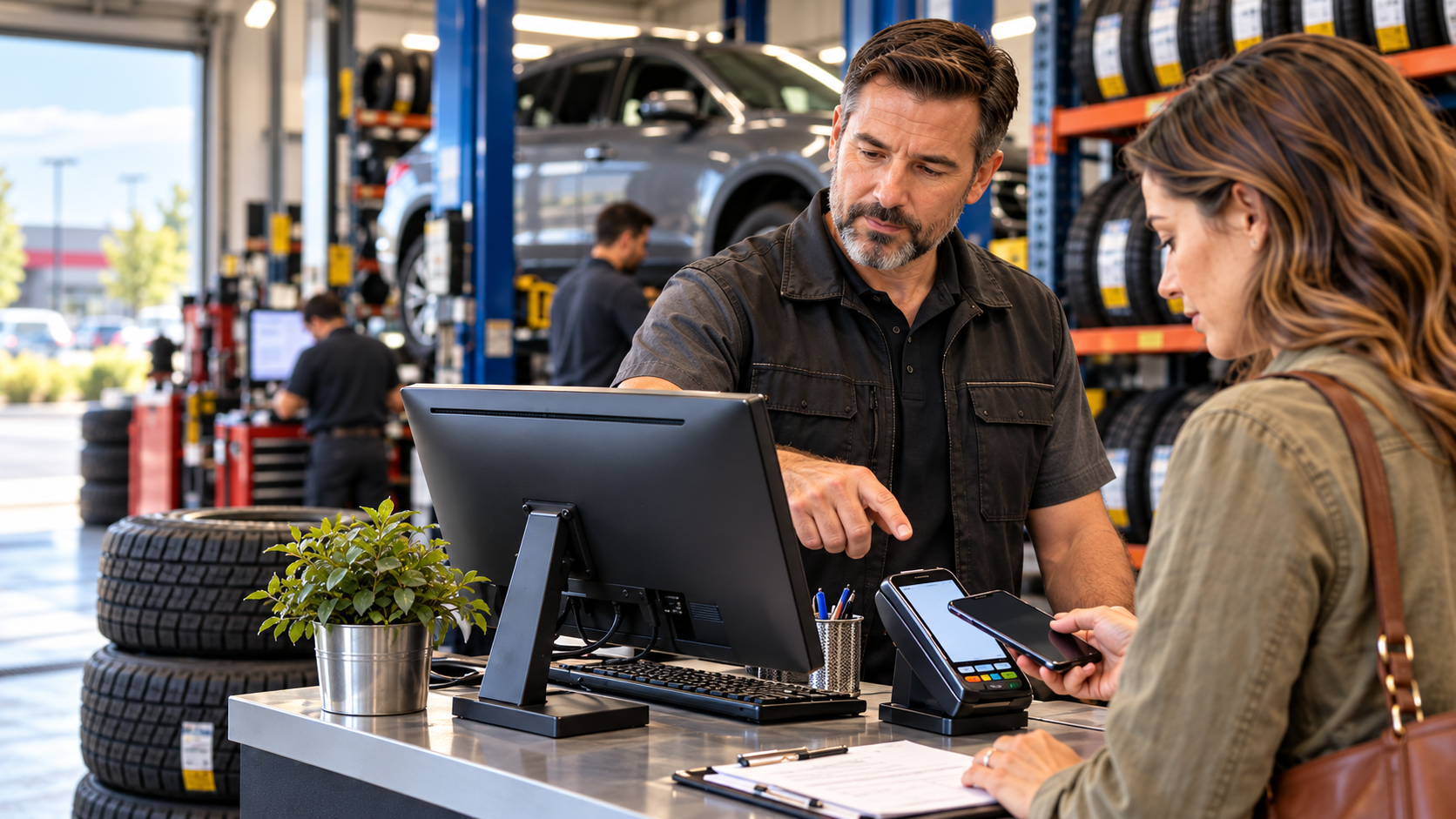
Private equity isn't just circling the tire industry anymore. It's buying it. The Pep Boys acquisition is the latest domino, and independent dealers are asking the same question: how do we compete when a newly-acquired competitor shows up down the street with bigger budgets and better tech, including tire shop payment processing that's faster than ours?
On a recent episode of the Full 360 Podcast, JP Brooks (Chief Revenue Officer, Fitment Group) and Josh Martalock (Director of Sales, Tire Guru and Protractor) broke down what consolidation means for independent dealers, and where the real competitive openings still are. Watch the full podcast here: https://youtu.be/BDyckr7sN3g
Three things stood out.
Fitment Group analyzes millions of retail tire prices every week, and Brooks pointed to a pattern a lot of independents still miss: treating every SKU like it needs the same margin. Some tires are heavily shopped and price-sensitive. Others, like AT/MT tires in colder climates, carry room to flex. Dealers without the technology to manage margin at the SKU level are guessing instead of pricing with intent.
Inflation is squeezing budgets. Brooks cited CPI running around 3.4%, with energy costs up nearly 15%, and wages not keeping pace. A $700 to $1,000 set of tires forces a decision, and consumers are shifting toward lower tiers. But affordability is only half the story. Customers now have far more SKUs, brands, and online price comparisons available than they did a decade ago. Dealers who can't show a transparent, competitive price in the moment lose the comparison before the sale even starts.
Josh told a story about his son dropping a truck off for repair and expecting to pay and pick it up the same day it finished, no matter what day that was. That's the bar now. Customers don't distinguish between a tire shop and a service shop. They want their vehicle handled, paid for, and off the lot without friction. Both guests pointed to the same operational gap behind this: dealers running five tabs of tire vendors, five tabs of parts vendors, and a disconnected point-of-sale system. That's the opposite of how the big-box competitors operate, and it's the gap PE-backed consolidators are exploiting.
Here's the part worth sitting with: Brooks was clear that the data and technology available to large retail chains is largely available to independents too. The gap isn't access. It's adoption. Independents still hold real advantages, including local trust, faster decision-making, and relationships that often run two or three generations deep. The dealers winning right now are the ones pairing that trust with the same pricing intelligence and integrated technology the big chains run on.
Every trend in this conversation points back to the same operational truth: disconnected tools create friction, and friction costs sales. That's true for pricing data and parts lookup, and it's just as true for how a customer pays. A customer who can't text to pay or finance a repair on the spot, or who has to wait through a slow card-reader fumble, is a customer who notices the gap between you and the shop down the street that just got bought by a consolidator.
That's the layer 360 Payments sits on. Integrated payments, text-to-pay, and compliant surcharging aren't nice-to-haves bolted onto a POS system. They're part of the same convenience and integration story Brooks and Josh described, just applied to the moment a customer settles the bill.
If you're evaluating payment processing for your tire shop, integrated payments, text to pay, and compliant surcharging are a faster, lower-lift place to close the technology gap than you might think.
Learn what drives shop valuation, how to prepare for a sale, and what buyers look for.

360 Payments is exhibiting at the 2026 Tire Pros National Dealer Conference, Sept 25–28 in Orlando.

See 360 Payments at ASTA Expo 2026! Booth 318, Sept 24–26, Raleigh, NC